


Why Your Roof Check Might Be Smaller Than You Expected
Key Takeaways: A roof surfacing payment schedule can lower your Florida roof claim payout because it pays a smaller share of replacement cost as your roof ages, even when the storm damage is real and covered. A separate roof deductible can shrink the check further. Under Florida law, that deductible is capped at the lesser of 2 percent of your dwelling coverage or 50 percent of the roof replacement cost, it generally does not apply to hurricane losses, and you may be able to opt out. Insurers may also hold payment at actual cash value until you prove you paid the roof deductible, while a covered total loss under the valued policy law generally must be paid without subtracting depreciation. If the insurer’s payment falls well short of a real contractor bid, reviewing your policy and getting legal guidance can help you challenge an underpaid roof claim.
A roof surfacing payment schedule can lower your Florida roof claim payout by tying what the insurer pays to your roof’s age, not the full cost of replacing it. Many Florida homeowners notice the problem after a storm, when the insurer’s payment is far less than a contractor’s replacement bid. A schedule endorsement, a separate roof deductible, and how the claim is valued can each shrink the check.
If your roof claim payment seems too low, you do not have to sort out the policy language alone. The property insurance team at Kuhn Raslavich, P.A. can review your policy and the insurer’s estimate. Call 877-352-7767 or contact us now to talk about your situation.
What Is a Roof Surfacing Payment Schedule?
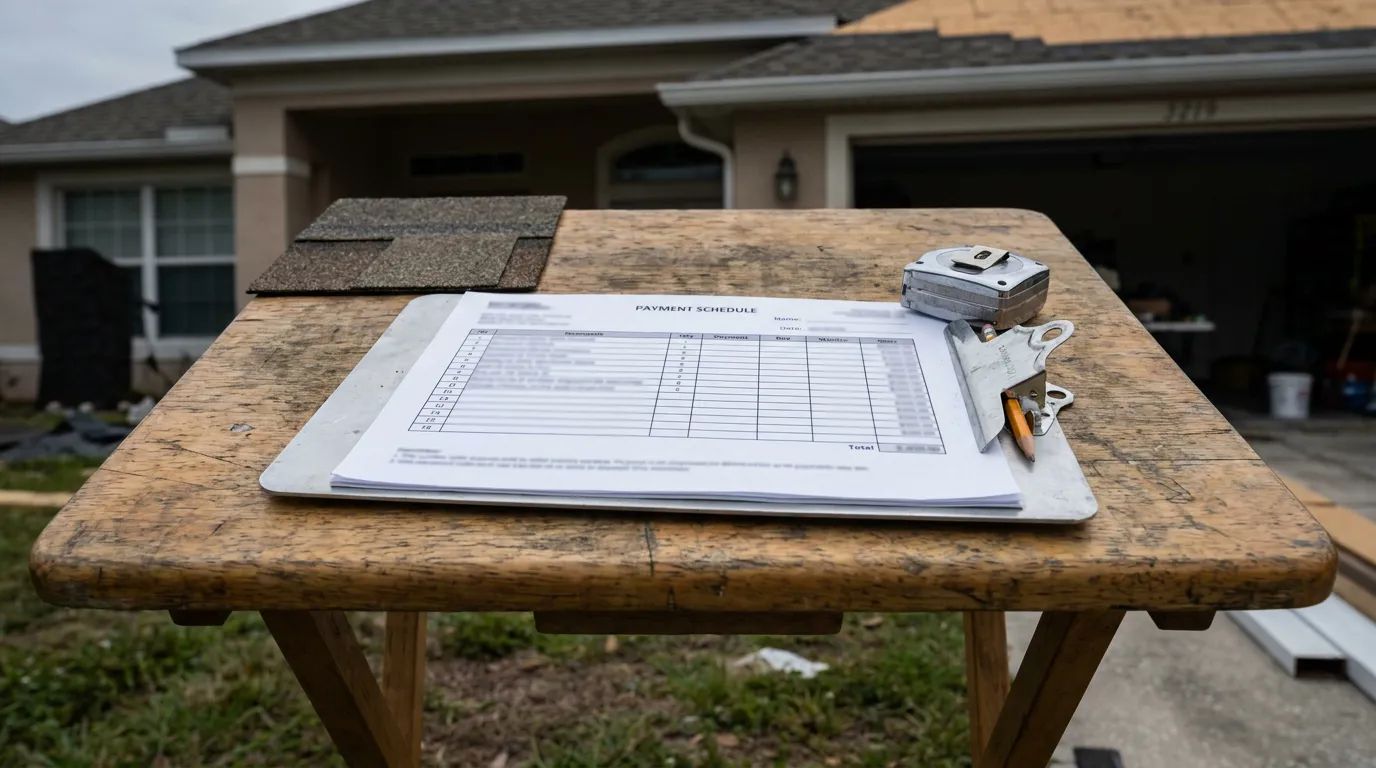
A roof surfacing payment schedule is a policy endorsement that pays for roof surface damage on a sliding scale based on the roof’s age and, often, its roofing material. As the roof gets older, the percentage of replacement cost the insurer agrees to pay goes down. A 15-year-old shingle roof might get only a fraction of what a new roof would cost, even when the damage is covered.
How a Schedule Endorsement Differs From Standard Coverage
Standard replacement cost coverage generally pays to repair or replace damaged property with materials of like kind and quality, without subtracting for depreciation. Under Florida Statutes § 627.7011(3)(a), for a dwelling insured at replacement cost, the insurer generally must first pay at least the actual cash value (ACV) of the loss, minus any applicable deductible, then pay the remainder as repairs are performed and costs are incurred. A roof schedule endorsement, where approved and included in the policy, can override that standard for roof surfacing by limiting payment according to its age-based table.
Why Insurers Use Roof Schedules
Insurers generally use roof schedules to control what they pay on older roofs. Florida’s property insurance market has faced heavy hurricane exposure and claim costs for years. For homeowners, the tradeoff is often a lower premium in exchange for a smaller roof claim settlement.
How Roof Payment Terms Can Reduce Your Florida Roof Claim
Several separate policy provisions can stack together and reduce your roof claim payout. Each has its own rules and limits under Florida law.
The Separate Roof Deductible
Florida allows insurers to add a separate roof deductible to personal residential policies, but the law limits its size. Under Florida Statutes § 627.701(10)(a), the roof deductible cannot be more than the lesser of 2 percent of the Coverage A (dwelling) limit or 50 percent of the cost to replace the roof. The policy must also include an actuarially sound credit or premium discount.
The roof deductible does not apply to every claim. Under § 627.701(10)(a), it applies only to claims adjusted on a replacement cost basis. It does not apply to:
-
A total loss under the valued policy law
-
A roof loss caused by a hurricane
-
A roof loss from a tree fall or other hazard that damages the roof and punctures the roof deck
-
A roof loss that requires repair of less than 50 percent of the roof
You may also have a right to opt out. Under § 627.701(10)(b)-(c), an insurer offering the roof deductible at first issuance must let you reject it on a form approved by the Office of Insurance Regulation. At renewal, the insurer may add it only through a notice of change in policy terms under § 627.43141 and must again give you the option to reject it. You can review these provisions in Florida’s insurance code.
ACV Holdbacks Tied to the Roof Deductible
When a separate roof deductible applies, the insurer may limit its initial roof payment to ACV until you prove you paid that deductible. Florida Statutes § 627.7011(3)(a) lists acceptable proof, including a canceled check, money order receipt, credit card statement, or a copy of a signed installment or financing contract.
💡 Pro Tip: Keep copies of every payment you make to your roofer, and send proof of your roof deductible payment to the insurer in writing so there is a dated record.
The Total Loss Contrast
A total loss is treated very differently from a partial roof claim. Under § 627.7011(3)(a) and the valued policy law in § 627.702, if a dwelling is a total loss from a covered peril, the insurer generally must pay the replacement cost coverage without reservation or holdback of depreciation.
|
Policy Term |
What It Can Do to Your Payout |
Key Florida Limit |
|---|---|---|
|
Roof surfacing payment schedule |
Pays a declining share as the roof ages |
Depends on endorsement terms and regulatory approval |
|
Separate roof deductible |
Subtracts a set amount from roof claims |
Lesser of 2% of Coverage A or 50% of roof replacement cost (§ 627.701(10)) |
|
ACV holdback |
Delays full payment until proof of deductible |
Allowed only under § 627.7011(3)(a) |
|
Total loss |
Generally no depreciation holdback |
§ 627.702 valued policy law |
Roof Age Rules That Protect Florida Homeowners
Florida law limits how insurers can use roof age against you when issuing or renewing a policy. These protections do not erase a schedule endorsement, but they can affect your coverage choices.
Under Florida Statutes § 627.7011(5)(b), an insurer may not refuse to issue or renew a homeowners policy insuring a structure with a roof less than 15 years old solely because of the roof’s age. For roofs at least 15 years old, § 627.7011(5)(c) lets the homeowner pay for an inspection by an authorized inspector, such as a licensed home inspector, building code inspector, roofing contractor, engineer, or architect. If the inspection shows at least 5 years of remaining useful life, the insurer may not refuse to issue or renew solely because of roof age. These rules apply to policies issued or renewed on or after July 1, 2022, and do not prevent an insurer from acting on other grounds, such as the roof’s actual condition.
An inspection report can also be useful evidence later. If an insurer argues your roof was worn out before the storm, a recent report may help counter that position.
Common Challenges With an Underpaid Roof Claim
The most common problem we see is a gap between the insurer’s estimate and the real cost of the work. Adjusters may use low unit prices, leave out code upgrades, or call a full replacement a “repair.” Our guide on how to compare an insurance estimate to a contractor bid walks through what to look for.
Assignment of benefits rules may also affect older roof claims. For agreements governed by Florida Statutes § 627.7152, the agreement must include a written, itemized, per-unit cost estimate, and the homeowner may generally rescind without penalty within 14 days after signing. You can read the assignment of benefits statute for details, though legislation effective January 1, 2023, prohibits assignment of post-loss benefits under policies issued on or after that date.
Deadlines That Can Affect Your Roof Claim Settlement
Timing matters in every Florida roof claim. Under Florida Statutes § 627.70132, notice of a new or reopened claim generally must be given within 1 year of the date of loss, and a supplemental claim within 18 months; older losses may be subject to different deadlines. Under § 627.70131, an insurer generally must pay or deny a claim, in whole or in part, within 60 days after receiving notice, unless “the failure to pay is caused by factors beyond the control of the insurer.”
Our Track Record With Roof and Storm Claims
Our attorneys have recovered millions fo dollars for Florida homeowners in roof-related hail and hurricane disputes. Past results do not guarantee a similar outcome, and every claim depends on its own facts.
Frequently Asked Questions
-
Can my insurer pay less because my roof is old?
It may, if your policy contains a roof surfacing payment schedule or similar endorsement. The reduction depends on the policy language.
-
Does the separate roof deductible apply to hurricane damage?
No. Under Florida Statutes § 627.701(10)(a), it does not apply to a roof loss caused by a hurricane, though your hurricane deductible may apply.
-
Can I remove a roof deductible from my policy?
Under § 627.701(10)(b)-(c), you may reject it by signing an approved form when it is offered at issuance or added at renewal.
-
What if my roof is over 15 years old?
You may pay for an inspection under § 627.7011(5)(c). If it shows at least 5 years of remaining useful life, the insurer may not refuse to issue or renew solely because of roof age.
-
How long do I have to file a roof claim in Florida?
Under § 627.70132, 1 year from the date of loss for new or reopened claims and 18 months for supplemental claims, though older losses may fall under prior deadlines.
Protecting Your Roof Claim Payout
A roof schedule endorsement, a separate roof deductible, and ACV holdbacks can each reduce what you receive, but Florida law places limits on how they are used. Reviewing your policy, documenting your roof’s condition, and comparing the insurer’s estimate to a real contractor bid can help you spot a reduced payment. If the numbers do not add up, a roof claim settlement lawyer can help you evaluate your options.
Do not let a confusing endorsement decide what your roof is worth. Reach out to Kuhn Raslavich, P.A. at 877-352-7767 or schedule your consultation so we can review your roof claim.
Disclaimer: This content is for informational purposes only and is not legal advice. Every case is unique, and results may vary. Consult an attorney about your specific circumstances.