


When Your Insurer Says No: Florida’s State-Run Mediation Option
Key Takeaways: Florida’s section 627.7015 mediation program lets policyholders request a state-administered claim resolution conference after a denial or underpayment, without first filing suit or entering appraisal. The Department of Financial Services administers the program and sets mediator rules. Policyholders, insurers, and assignees may request a conference, though insurers generally aren’t required to participate when a third-party assignee makes the request. Eligibility covers personal lines and commercial residential property claims but excludes commercial coverages, private passenger auto, and liability disputes. Gather your denial letter, policy provisions, photographs, estimates, and the DFS request form. Two 2025 bills would have changed the process but neither passed, so the current statute governs. A mediator cannot impose an outcome, leaving appraisal, breach of contract, or statutory remedies as next steps.
A denied property insurance claim doesn’t have to end at your carrier’s letter. Florida law gives policyholders a state-administered path through a mediated claim resolution conference. Under section 627.7015 of the Florida Statutes, this process is informal, nonadversarial, and available before you commit to appraisal or litigation. For homeowners, condominium owners, and business owners facing a property damage claim denial, it can be among the fastest structured conversations available.
If you’re weighing options after a denial, the team at Kuhn Raslavich, P.A. can help you evaluate whether mediation, appraisal, or suit best fits your facts. Call 877-352-7767 or contact us now to discuss your claim.
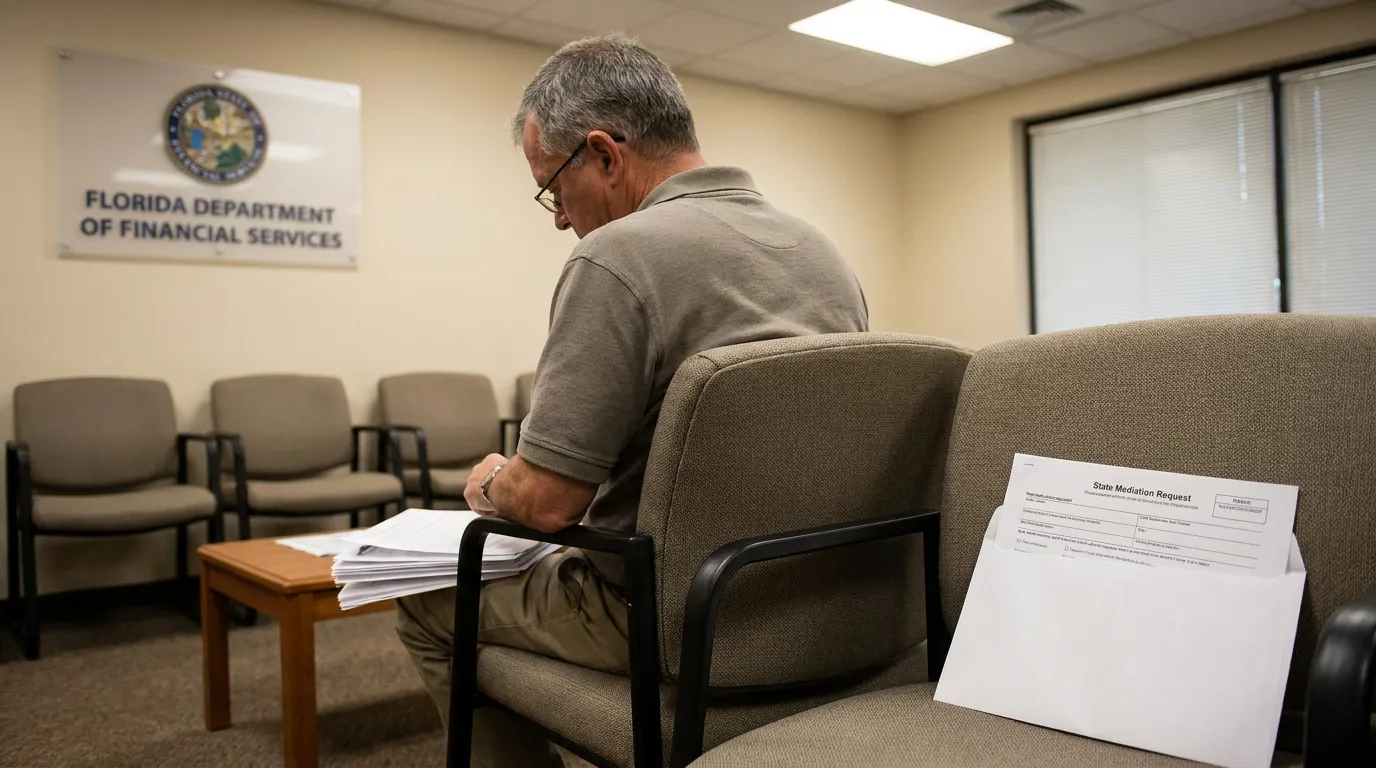
What the Florida 627.7015 Mediation Program Actually Is
The statute creates a nonadversarial alternative dispute resolution procedure for a mediated claim resolution conference. Rather than immediately litigating coverage, the parties sit down with a neutral mediator assigned through a state program and try to close the gap on disputed facts and dollars.
The Department of Financial Services administers the program and adopts the governing rules. The mediation is a state process separate from any civil lawsuit you might later file. The Department’s rules for scheduling and conference conduct are split across two rules: Florida Administrative Code Rule 69J-166.002 (covering commercial residential property insurance claims) and Rule 69J-166.031 (covering residential property insurance claims). Mediator qualifications for the program are separately codified in Rule 69B-250.002. Mediation under the statute is also available to litigants referred by a county court or circuit court.
Who May Request a Conference
Mediation may be requested by the policyholder as a first-party claimant, by a third party as an assignee of policy benefits, or by the insurer. Most requests come from policyholders after a denial or lowball estimate. Insurers subject to the statute are generally required to notify first-party claimants of their right to participate in the program. The statute permits participation by legal counsel when the policyholder requests mediation.
An important limitation may apply to assignees. An insurer is generally not required to participate in any mediation requested by a third-party assignee of the policy benefits. If you signed an assignment of benefits with a contractor, the practical value of a policyholder mediation request may change.
Timing: Why Mediation Comes Early in Florida Insurance Dispute Steps
The statute generally makes mediation available with respect to claims under personal lines and commercial residential policies before commencing appraisal or litigation. That sequencing is the practical heart of the program. A policyholder who receives a denial can generally request mediation without first surrendering to a contractual appraisal or filing suit. If the insurer fails to comply with the mediation requirements, the policyholder generally is not required to submit to appraisal as a precondition to legal action.
Timing still interacts with hard statutory deadlines that mediation generally does not pause. Under § 627.70132, Fla. Stat., a claim or reopened claim for property insurance must generally be filed within one year after the date of loss, and a supplemental claim within eighteen months. Separately, § 627.70131, Fla. Stat., addresses the insurer’s obligation to pay or deny a claim within 60 days after notice, though that duty is subject to exceptions. Courts may interpret extensions and exceptions to filing deadlines narrowly, so no policyholder should assume a pending mediation preserves a lapsed deadline.
💡 Pro Tip: Calendar your date of loss the day you report damage. Mediation scheduling can take weeks, and a request filed close to a statutory cutoff may leave little room to pivot to other Florida claim denial options.
Practical Steps for a Mediation Application in Florida
Requesting mediation is largely a documentation exercise, and the quality of your paperwork often shapes the conference. The Department’s process is designed to be accessible without counsel, but preparation can still influence whether the carrier arrives ready to move. Consider working through the following before you submit:
-
Locate your denial or partial payment letter and the specific policy provisions the carrier cited
-
Gather dated photographs, repair estimates, invoices, and any independent damage evaluation
-
Confirm your policy type is eligible
-
Complete the mediation request form DFS provides with your claim number and loss details
-
Identify who will attend for you, and decide whether you want legal counsel present
The conference itself is generally informal. A neutral mediator facilitates discussion; ordinarily no one issues findings of fact or a binding coverage ruling unless the parties reach and sign an agreement. Department rules generally give an unrepresented policyholder a short window after signing to rescind a mediation settlement, and the insurer generally bears the cost of the mediation. Outcomes depend heavily on the strength of your damage documentation and policy language.
Claims the Program Does Not Reach
Not every dispute qualifies. The statute generally does not apply to commercial coverages, to private passenger motor vehicle insurance coverages, or to disputes relating to liability coverages in policies of property insurance. Mediation is also generally unavailable where the insurer has a reasonable basis to suspect fraud and reports the matter as the statute requires.
|
Generally Eligible |
Generally Excluded |
|---|---|
|
Personal lines residential property claims |
Commercial coverages |
|
Commercial residential property claims |
Private passenger motor vehicle coverages |
|
Court-referred property claim disputes |
Liability coverage disputes under property policies |
You can read the full statutory framework within Chapter 627 insurance statutes to confirm how your policy type fits.
What Recent Legislation Proposed and Why It Did Not Change the Rules
Two 2025 bills would have reshaped this process, and neither became law. SB 224 (2025) was an act relating to the resolution of disputed property insurance claims, amending s. 627.7015, F.S. It died in Banking and Insurance on June 16, 2025. The existing, unamended version of the statute therefore remains the governing mediation procedure.
SB 1508 (2025) went considerably further. It proposed establishing a mandatory procedure for resolution of disputed insurance claims through the Division of Administrative Hearings. The bill did not become law, having been indefinitely postponed and dying in the Senate Banking and Insurance Committee. Because the bill did not pass, none of its proposed changes is law.
When Mediation Is Not Enough
A mediator generally cannot impose a result, so a carrier may attend and still refuse to move. If the conference does not resolve a homeowners claim in Florida, the remaining paths may include the policy’s appraisal provision, a breach of contract action, or, in narrower circumstances, statutory remedies. Which route fits depends on your policy language, the nature of the dispute, and the posture of the claim.
Bad faith is a separate and more demanding track. Under § 624.1551, Fla. Stat., a named or omnibus insured or a named beneficiary must generally have established through an adverse adjudication by a court of law that the property insurer breached the insurance contract, with a final judgment or decree rendered against the insurer, as a condition precedent to such an action. A policyholder considering that path should understand it typically follows, rather than replaces, the underlying contract case. Our attorneys handling property insurance claims can assess where your dispute realistically stands.
Frequently Asked Questions
1. Does requesting mediation waive my right to sue later?
Nothing in section 627.7015 conditions your right to pursue litigation on the outcome of a mediation conference. The statute generally positions mediation as available before commencing appraisal or litigation. Any agreement you sign at the conference may resolve the disputed issues, subject to any limited rescission period the Department’s rules provide.
2. Can I bring an attorney to the mediation conference?
Yes. Where the policyholder requests mediation, participation by legal counsel is permitted under the statute. Many policyholders bring counsel when the disputed amount is substantial or the denial rests on complex policy exclusions.
3. Is mediation available if my claim involves a commercial building?
It depends on the policy. The program generally reaches commercial residential policies, but the statute generally does not apply to other commercial coverages. Review your declarations page to confirm eligibility.
4. What if I signed an assignment of benefits with my contractor?
That can complicate matters. An insurer is generally not required to participate in mediation requested by a third-party assignee of the policy benefits. Reviewing the assignment language before requesting mediation is advisable.
5. Did the 2025 legislation make mediation mandatory?
No. SB 224 died in the Senate Banking and Insurance Committee, and SB 1508 did not become law. Under the current statute, an eligible policyholder generally may request mediation and an insurer subject to the statute is generally expected to participate, but no one can be forced to settle, and the statute’s exclusions still apply.
Turning a Denial Into a Conversation
State mediation is one of the more accessible tools Florida gives policyholders after a claim denial. It is informal by design, generally available early, administered by the Department of Financial Services, and generally open to representation by counsel when the policyholder requests it. It is also limited: certain coverages fall outside it, assignees generally cannot compel insurer participation, and a mediator generally cannot order a carrier to pay. Results turn on the specific policy language and the evidence you assemble. Readers wanting more background can review our Florida insurance dispute steps library.
If your carrier has denied or underpaid a storm, water, fire, or hail loss, Kuhn Raslavich, P.A. is prepared to review your policy and discuss the florida 627.7015 mediation program alongside your other remedies. Call 877-352-7767 or reach our team through the firm’s property claim attorneys page to get started.
Disclaimer: This content is for informational purposes only and is not legal advice. Every case is unique, and results may vary. Consult an attorney about your specific circumstances.