


When Building Codes Turn a Repair Into a Rebuild
Key Takeaways: Ordinance or law coverage pays the increased cost of repairing or rebuilding Florida property when current building codes demand more than restoring what existed before the loss. Standard replacement cost coverage generally excludes these code-driven expenses under Fla. Stat. § 627.7011(1)(a), leaving a gap this endorsement fills. Florida insurers must offer the coverage under § 627.7011(1), and under § 627.7011(2) a dwelling policy is deemed to include law and ordinance coverage of 25 percent of the dwelling limit unless the policyholder signs a written refusal on an approved form; the policyholder may instead select a 50 percent limit. Payment typically applies only to repairs of the damaged portion of a structure unless total damage exceeds 50 percent of replacement cost, a threshold that drives many disputes. Common covered costs include code-required demolition, debris removal, roof-to-wall connections, and system upgrades triggered by permits. Notice deadlines under §§ 627.70131 and 627.70132, along with the bad faith prerequisites in § 624.1551, can determine whether a code upgrade claim survives.
Ordinance or law coverage pays the increased cost of repairing or rebuilding your property when current building codes require more than restoring what existed before the loss. Under Fla. Stat. § 627.7011(1), Florida insurers must offer the coverage options defined by the statute, and under § 627.7011(2) the policy is deemed to include coverage limited to 25 percent of the dwelling limit unless the insurer obtains the policyholder’s written refusal. Without it, a covered hurricane, fire, or water loss can leave you paying for mandatory code upgrades your standard replacement cost payment won’t cover.
If your carrier has denied or underpaid a claim involving code-required upgrades, the attorneys at Kuhn Raslavich, P.A. can review your policy and explain your options. Call 877-352-7767 or contact us now to discuss your situation with a Florida property insurance attorney.
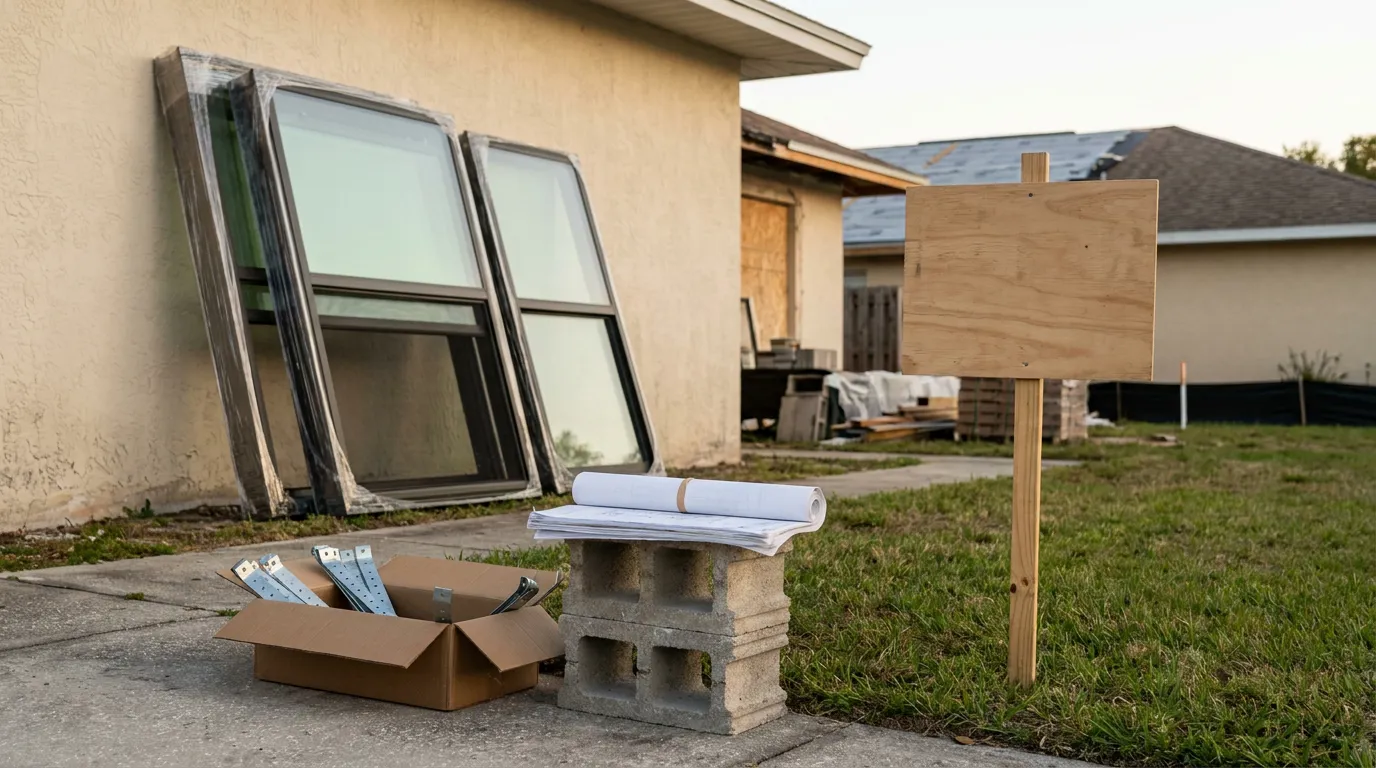
The Coverage Gap Standard Replacement Cost Leaves Behind
Most Florida homeowners assume replacement cost coverage means the insurer pays whatever it takes to rebuild, but that assumption breaks down quickly. Under Fla. Stat. § 627.7011(1)(a), the replacement cost option does not include costs necessary to meet applicable laws and ordinances regulating construction, use, or repair, or requiring the tearing down of property, including debris removal costs.
That exclusion matters after a significant loss. If a county inspector requires demolishing an undamaged wall for compliance, or mandates upgraded roof decking, hurricane straps, or electrical systems, standard replacement cost coverage generally doesn’t reach those expenses. This is the gap ordinance or law coverage is designed to fill.
How Ordinance or Law Coverage Florida Policies Actually Work
When a policyholder carries the coverage described in Fla. Stat. § 627.7011(1)(b), the policy may cover added costs of meeting current codes, subject to statutory caps. Florida law permits insurers to limit that benefit to either 25 percent or 50 percent of the dwelling limit, as selected by the policyholder. Coverage applies only to repairs of the damaged portion of the structure unless total damage exceeds 50 percent of replacement cost.
That 50 percent threshold is among the most frequently litigated features of this coverage. A carrier may argue damage falls below the threshold, limiting payment to the damaged portion only, while a policyholder’s contractor may reach a different conclusion. These disputes tend to be fact-dependent, often turning on competing damage estimates rather than policy wording alone.
The Statutory Offer Requirement
Before issuing a homeowner’s policy, a Florida insurer must offer the coverage options set out in Fla. Stat. § 627.7011(1). If the policy already contains law and ordinance coverage limited to 25 percent of the dwelling limit, the insurer need not repeat the full offer, but must still offer coverage limited to 50 percent. The practical effect: Florida homeowners generally have access to at least one of these two tiers.
Section 627.7011(2) supplies the default: absent a written refusal, the dwelling policy is deemed to include coverage limited to 25 percent of the dwelling limit, and any rejection or alternative selection must be made on a form approved by the Office of Insurance Regulation that fully advises the applicant of the coverage being rejected. Review the full text of Florida’s dwelling replacement cost statute before your next renewal.
Where the Money Typically Goes
Code upgrade coverage tends to be consumed by expenses that surprise policyholders because they feel unrelated to the actual damage. Common categories include:
-
Demolition and removal of undamaged portions required by local ordinance
-
Debris removal costs tied specifically to code compliance
-
Roof-to-wall connection and secondary water barrier upgrades under the Florida Building Code
-
Electrical, plumbing, and mechanical system upgrades triggered by permit thresholds
-
Elevation, egress, or accessibility requirements imposed during permitted reconstruction
💡 Pro Tip: Ask your permitting office for the written code citation behind each required upgrade. A documented code reference is often more persuasive to an adjuster than a contractor’s verbal explanation.
Why Florida’s Construction Rules Drive These Disputes
Florida construction projects are governed by a layered framework of state statutes and local building codes that property owners must satisfy when repairing or rebuilding. The Florida Bar Journal’s overview of statutes affecting Florida construction outlines the regulatory structure governing construction activity, including compliance requirements that surface during post-loss reconstruction.
That framework explains why carriers sell a separate building ordinance endorsement in the first place. Because standard property policies generally exclude the added cost of bringing a damaged structure up to current code, the endorsement transfers that risk back to the insurer. Understanding this helps policyholders recognize when a denial reflects a genuine policy limitation versus an overly narrow reading of the endorsement.
|
Coverage Feature |
Standard Replacement Cost |
Ordinance or Law Endorsement |
|---|---|---|
|
Restoring damaged materials in kind |
Generally covered |
Not the primary purpose |
|
Code-required upgrades |
Generally excluded |
Generally covered, subject to limits |
|
Demolition of undamaged portions |
Generally excluded |
May be covered |
|
Code-related debris removal |
Generally excluded |
May be covered |
|
Statutory limit |
Dwelling limit |
25% or 50% of dwelling limit |
Deadlines That Can Quietly Undermine a Code Upgrade Claim
Even a well-supported rebuild cost claim can fail if notice deadlines pass. Fla. Stat. § 627.70132 bars a claim or reopened claim unless notice is given within one year of the date of loss, and bars a supplemental claim unless notice is given within 18 months, with limited exceptions such as tolling during a servicemember’s qualifying deployment and a separate timeframe for loss assessment coverage. For hurricanes and certain weather events, the statute fixes the date of loss as the date of landfall or the date verified by NOAA. These deadlines apply to any Florida property claim, including code upgrade disputes.
Separately, Fla. Stat. § 627.70131 governs the insurer’s obligation to pay or deny a claim within the statutory period after notice, generally 60 days under the current statute, except where failure to pay is caused by factors beyond the insurer’s control. Whether a delay qualifies is fact-sensitive and often depends on what the carrier did, and when, during the investigation.
💡 Pro Tip: Ordinance or law expenses frequently emerge months into reconstruction, after permits are pulled. Track those dates carefully, they can affect whether a supplemental claim is timely under § 627.70132.
When a Denial May Cross Into Unfair Claim Handling
Fla. Stat. § 626.9541(1)(i) enumerates unfair claims settlement practices, and several may map onto how ordinance or law disputes go wrong. The statute identifies conduct such as failing to promptly investigate claims, misrepresenting policy provisions, and failing to affirm or deny coverage within a reasonable time. These principles may be implicated when a carrier improperly denies or delays a code-upgrade claim.
Regulatory standards under the Florida insurance code, administered by the Office of Insurance Regulation, are distinct from a civil lawsuit for policy benefits. Under Fla. Stat. § 624.1551, a condition precedent to a property insurance bad faith action is that the insured or beneficiary has established, through an adverse adjudication and a final judgment or decree, that the insurer breached the insurance contract.
Because § 624.155(5)(a) also provides that mere negligence alone is insufficient to establish bad faith, these claims generally depend on the overall pattern of the carrier’s conduct rather than a single letter, and no outcome is assured. A policyholder pursuing full benefits generally must first prove coverage, a covered loss, and the measure of damages before any extracontractual claim becomes available.
Reading Your Declarations Page Before a Loss
The fastest way to find out whether you carry this protection is to read your declarations page and endorsement schedule now, not after a storm. Look for a line referencing law and ordinance coverage and note whether it shows 25 percent or 50 percent of Coverage A. Understanding how the dwelling limit interacts with other parts of your policy is easier once you have homeowners insurance coverage explained in plain terms.
The nonprofit United Policyholders publishes insurance consumer rights in Florida as part of its claim guidance series, explaining policyholder rights, claim filing steps, and commonly misunderstood coverage types under Florida homeowners policies. Because United Policyholders is a 501(c)(3) nonprofit rather than an insurer or law firm, its materials offer a neutral starting point, though they’re not a substitute for reading your own policy or obtaining legal advice.
A Firm That Litigates Underpaid Florida Property Claims
Kuhn Raslavich, P.A. represents policyholders, not carriers, in first-party residential and commercial property disputes across Florida. The firm’s recent results include a $175,000 recovery in a denied Hurricane Milton claim in Orange County handled by attorney Shannon Whitesell, a $200,000 recovery in an underpaid Hurricane Milton claim in Manatee County handled by attorney Jennifer J. Smith, and a $299,200 recovery in an underpaid pipe leak claim in Seminole County. Firm attorneys Jennifer J. Smith and Kevin M. Conneran have received peer-reviewed recognition from Super Lawyers Magazine, a list that recognizes a limited percentage of eligible attorneys in each state following peer nominations, independent research, and peer evaluation.
Past results do not predict or guarantee the outcome of any future matter, and every claim depends on its own policy language and facts. If your carrier has undervalued code-required reconstruction, an ordinance or law coverage Florida lawyer can evaluate the estimate, the endorsement, and the applicable statutory limits.
Frequently Asked Questions
1. Is ordinance or law coverage automatically included in my Florida policy?
Often, but not in the amount you might expect. Under Fla. Stat. § 627.7011(2), a dwelling policy is deemed to include coverage limited to 25 percent of the dwelling limit unless the insurer obtains the policyholder’s written refusal on an approved form, and a policyholder may instead select a 50 percent limit. Your declarations page and endorsements control, so review them directly.
2. Why did my insurer pay only for the damaged portion of my home?
Under Fla. Stat. § 627.7011(1)(b), this coverage applies only to repairs of the damaged portion unless total damage exceeds 50 percent of the structure’s replacement cost. Disputes commonly center on whether that threshold has been met, which typically requires competing damage and valuation analysis.
3. Does this coverage apply to commercial buildings and condominiums?
Commercial and association policies often contain ordinance or law provisions, though the offer requirements in § 627.7011 are directed at homeowners’ policies covering dwellings. Association and commercial forms vary, so the specific endorsement language generally governs.
4. What if code upgrade costs appear after my claim is already closed?
Florida law sets deadlines for reopened and supplemental claims under § 627.70132, generally one year from the date of loss for a reopened claim and 18 months for a supplemental claim. Missing them can bar recovery, so act promptly once permits identify new requirements.
5. Can I pursue bad faith if my carrier refuses to pay code upgrade costs?
Only under specific conditions. Fla. Stat. § 624.1551 requires an adverse adjudication and a final judgment establishing breach of the insurance contract before a property insurance bad faith action may proceed, and under § 624.155(5)(a) negligence alone is not enough to establish bad faith.
Protecting the Full Value of Your Rebuild
Ordinance or law coverage exists because Florida’s building codes often require more than a like-for-like repair after storm, fire, or water damage. Fla. Stat. § 627.7011 sets the offer requirements, the default 25 percent coverage absent a written refusal, the 25 percent and 50 percent limits, and the 50 percent total-damage threshold that shapes so many disputes, while §§ 626.9541, 627.70131, 627.70132, and 624.1551 govern claim handling, deadlines, and extracontractual remedies. Outcomes depend heavily on policy language, the scope of damage, the applicable statute version, and documentation of the specific code provisions being enforced.
If an insurer has denied, delayed, or underpaid a property damage claim involving code-required upgrades, the property insurance attorneys at Kuhn Raslavich, P.A. are ready to help you evaluate it. Call 877-352-7767 or reach out to our team to schedule a consultation about your Florida property insurance claim.
Disclaimer: This content is for informational purposes only and is not legal advice. Every case is unique, and results may vary. Consult an attorney about your specific circumstances.